
How to import data from Excel
This section walks you through the complete process of bringing data from an Excel file into the system.
Step 1. Access the upload feature
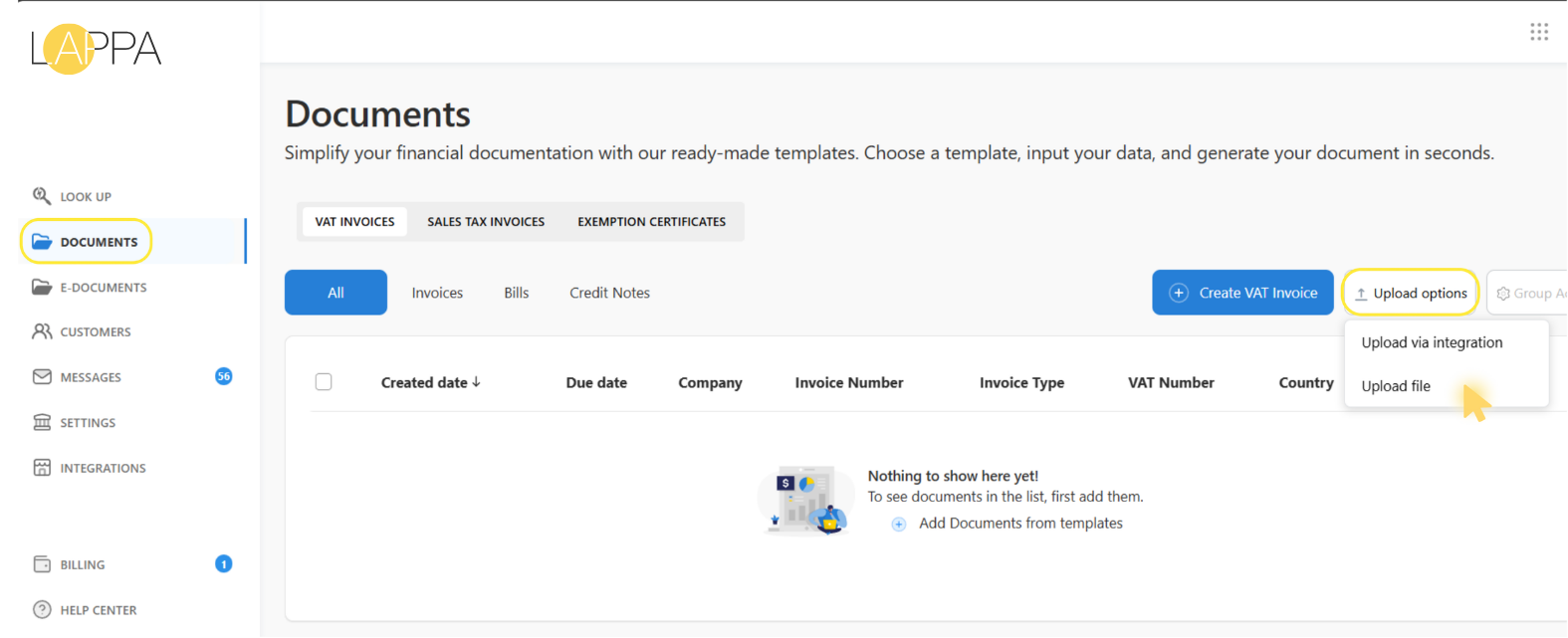
Go to the Documents section in the application. Click the “Upload options” button and choose “Upload file” from the dropdown that appears.
Step 2. Select and upload your Excel file
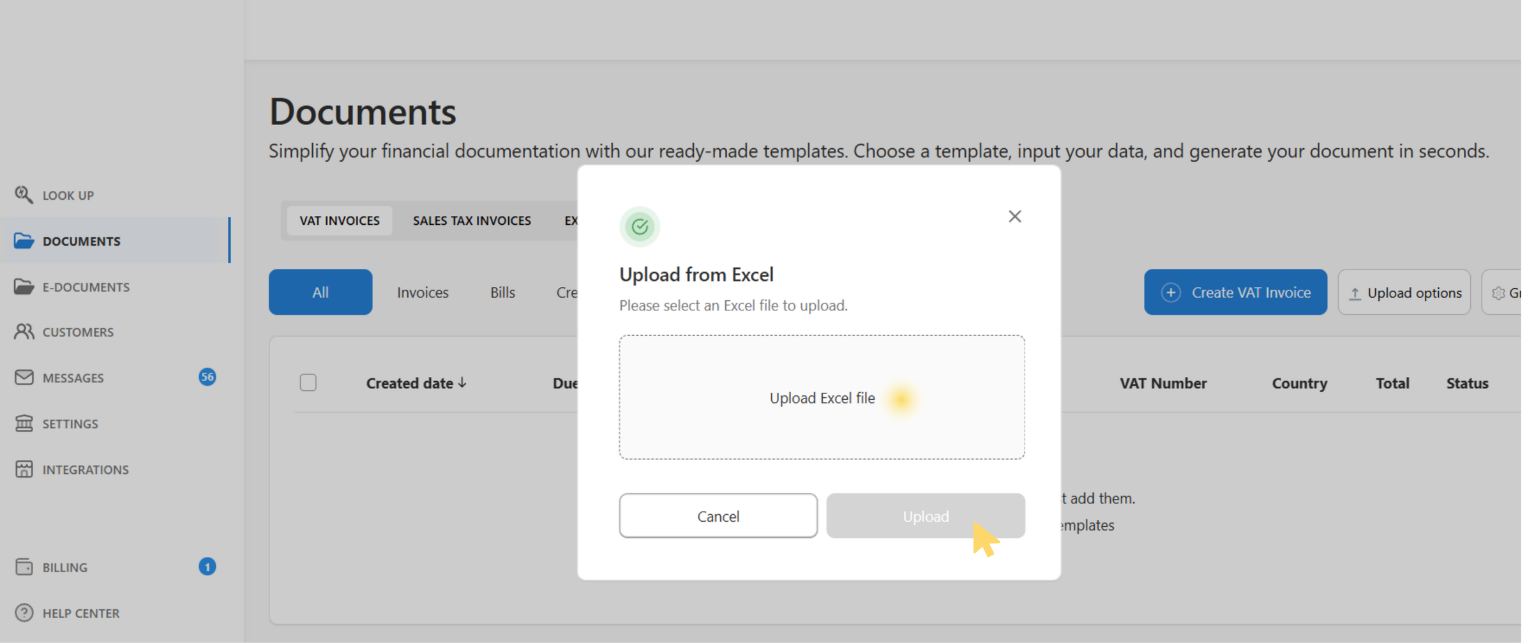
In the “Upload from Excel” dialog window, click the upload area or use the file browser to locate your Excel file (.xlsx or .xls format). After selecting the file, click “Upload” to continue.
Download Excel templates
Before preparing your Excel file, you can download either a pre-filled sample to understand the expected format, or a blank template ready for your own data.
Note: The sample file includes test data to illustrate the required format. The blank template contains only column headers for you to populate with your own information.
Overview: This guide outlines the structure of the Excel file used to bring customers, invoices, and bank details into the system. The file must contain between one and three sheets: Customers, Invoices, and Banks.
1. File structure
The Excel file must be in .xlsx or .xls format and may contain the following sheets:
- Customers (or a sheet with a name containing “customer”) – customer information
- Invoices (or a sheet with a name containing “invoice”) – invoice information
- Banks (or a sheet with a name containing “bank”) – bank account details
2. Customers sheet
This sheet stores customer records. Each row beginning from the second represents a single customer.
| Field | Required | Data Type | Max Length | Description |
| Customer ID | Required | Text/Number | – | Unique customer identifier in the Excel file. Used to link invoices. |
| Name | Required | Text | 255 characters | Customer company name. Must be unique for each customer. |
| Required | 50 characters | Email for sending invoices. Must be in the format: user@example.com | ||
| Contact person | Required | Text | 75 characters | Name of the contact person |
| Peppol ID | Optional | Text | 25 characters | Peppol identifier for electronic document exchange. Required only when the sending method is PINT or BIS3 |
| Tax number | Required | Text | 25 characters | Customer’s tax identification number (VAT number) |
| Country | Required | Text | – | Customer’s country. You may specify a country code (e.g. “DE”, “US”), ISO code (e.g. “DEU”, “USA”), or full country name (e.g. “Germany”, “United States”) |
| City | Required | Text | 30 characters | City |
| State | Optional | Text | 30 characters | State/Province/Region |
| Address line 1 | Required | Text | 75 characters | First line of the address (street, house number) |
| Address line 2 | Optional | Text | 40 characters | Second line of the address (additional information) |
| Postal code | Required | Text | 12 characters | Postal code |
| Language | Required | Text | – | Language for PDF documents. Allowed values: EN, FR, DE, IT, ES, ZH, PL, LV, ET.You may specify a code or a full name (e.g. “English” will be converted to “EN”) |
| Sending method | Required | Text | – | Invoice sending method. Allowed values: BIS3, PINT, Email, Croatia (Fiskalizacija 2.0). Default: BIS3 |
3. Invoices sheet
This sheet contains invoice data. Each invoice is made up of one header row (Header) and one or more item rows (Item).
Important: Every invoice must begin with a row of type “Header”, followed by one or more “Item” rows for each product or service. The next invoice starts with a new “Header” row.
3.1. Header row fields (invoice header)
| Field | Required | Data type | Description |
| Row type | Required | Text | Must be Header (case-insensitive) |
| Invoice number | Required | Text | Invoice number. Must be unique for the company |
| Customer ID | Required | Text/Number | Customer ID from the Customers sheet. Must exist in the system |
| Invoice date | Required | Date | Invoice creation date. Format: DD/MM/YYYY |
| Due date | Optional | Date | Invoice due date. Format: DD/MM/YYYY |
| Currency | Required | Text | Currency code (e.g., EUR, USD, GBP). Default: EUR |
| Order reference | Optional | Text | Order number/reference |
| Status | Required | Text | Invoice status. Allowed values: new, pending, sent, paid |
| Bank ID | Optional | Text/Number | Bank ID from the Banks sheet. If not specified, default bank data from settings will be used (local or global depending on whether the company’s and customer’s countries match) |
| Seller VAT number | Optional | Text | Seller’s VAT number |
| Seller sales tax number | Optional | Text | Seller’s sales tax number |
| Seller tax ID | Optional | Text | Seller’s tax identification number |
| Total | Required | Number | Total invoice amount (including taxes) |
| Total excluding tax | Required | Number | Amount excluding taxes |
| Total tax amount | Required | Number | Total tax amount |
| Total discount amount | Required | Number | Total discount amount |
| Note | Optional | Text | Invoice note |
| Document type | Optional | Text | Type of the document. Allowed values: invoice (default), credit note |
| References invoice number | Conditional | Text | Number of the original invoice this document corrects. Required only when Document type is credit note, ignored otherwise |
3.2. Item row fields (product/service)
| Field | Required | Data type | Description |
| Row type | Required | Text | Must be Item |
| Item description | Required | Text | Description of the product or service. Rows without a description will be skipped |
| SKU | Optional | Text | Product SKU |
| Quantity | Required | Number | Quantity |
| Unit price | Required | Number | Price per unit |
| Discount | Optional | Number | Discount amount |
| Discount type | Optional | Text | Discount type: amount (fixed amount) or percentage (%) |
| Tax rate | Optional | Number | Tax percentage (e.g., 20 for 20%) |
| Tax type | Optional | Text | Tax type. Allowed values: SalesTax, VAT, GST, NoTax. |
4. Banks sheet
This sheet holds bank account details. Each row starting from the second represents one bank account.
| Field | Required | Data type | Max length | Description |
| Bank ID | Required | Text/Number | – | Unique bank identifier in the Excel file. Used to link with invoices |
| Name of the bank | Required | Text | 60 characters | Name of the bank |
| Bank type | Required | Text | – | Bank type: local or global |
| Currency | Required | Text | 3 characters | Account currency (e.g., EUR, USD) |
| Account holder | Required | Text | – | Account holder name |
| Account Number | Required | Text | – | Account number (IBAN or other format) |
| SWIFT/BIC | Optional | Text | – | SWIFT/BIC code of the bank |
| IBAN | Optional | Text | – | IBAN |
| Routing number | Optional | Text | – | Routing number of the bank |
| Sort code | Optional | Text | – | Sort code of the bank |
Note on bank data: Bank information is not mandatory. If default bank details have already been configured in system settings, they will be pulled in automatically when invoices are created. The selection logic works as follows:
- If the company’s country matches the customer’s country, then local default bank data will be used.
- If the countries differ, then global default bank data will be used.
Example: If both the company and customer are based in Canada, local default bank details will be used. If they are in different countries (e.g., company in Canada, customer in the USA), global default bank details will apply instead.
5. Processing order
The system processes the data in the following order:
- Customers – customers are created/updated first
- Banks – then bank details are created/updated
- Invoices – invoices are created/updated last (they reference Customers and Banks)
Important: Ensure that the Customer ID and Bank ID referenced in the Invoices sheet match the IDs defined in the Customers and Banks sheets. If a matching customer or bank entry is not found, the invoice will not be created.
Frequently Asked Questions (FAQ)
Can I import invoices without including customers?
No. Customers must be present in the import since invoices reference them via Customer ID.
What happens if a Customer ID in the invoice doesn't match any customer?
The invoice will not be created, and an error message will be shown in the processing results describing the issue.
How do I add multiple line items to a single invoice?
Place multiple Item rows directly after the Header row. Each Item row represents one product or service on the invoice.
What is the difference between "amount" and "percentage" discount types?
- amount – a fixed discount amount (e.g., 50.00 EUR)
- percentage – a percentage discount (e.g., 10 means 10% of the amount)
Still have questions?
Contact us support@lappa.org